Blasts on Jupiter's moons. Learn details
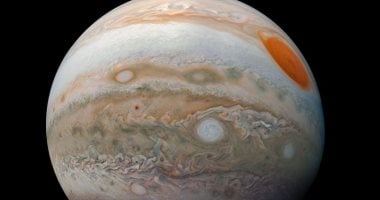
NASA's Voyager spacecraft picked up images that could lead to new visions of Jupiter's interactions with its five moons, where the spacecraft's Juno probe detected giant volcanic eruptions on the moon, "Ao", one of Jupiter's moons.
Ayo is one of the most volcanic objects in our solar system. Juno's cameras took four pictures of him on Dec. 21 during the 17th mission of Jupiter.
"We knew we were starting a new campaign with our polar vision in Ayu, but no one expected that we would be so lucky to see an active volcanic material on the surface," said Scott Bolton, a member of the Juno mission and associate vice president of space science and engineering at the Southwest Research Institute. The surface of the moon".
These volcanic eruptions produce the gravitational interaction between the Jupiter and its moon "Io", emitting columns of sulfur dioxide that resemble umbrellas and produce large fields of basaltic lava.
21 Heidi Becker, head of NASA's Radiation Monitoring Division, said that we were given a unique opportunity to observe Io's volcanic activity using the SRU module, using only the European moonlight as our own lamp. The JIRAM instrument senses heat at long wavelengths, hot spots in daylight and Night.
"Although Jupiter's satellites are not the core targets of JIRAM, the closer we pass, the more we take advantage of the opportunity to observe," said Alberto Adriani, a researcher at the National Institute of Astrophysics in Italy.
Related topics


Post a Comment