The Astronomy Institute opens doors tomorrow for the public to monitor Jupiter with astronomical telescopes
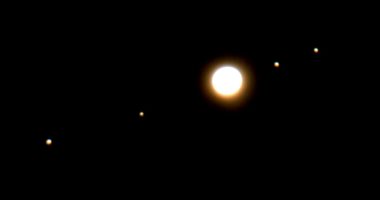
The National Institute of Astronomical Research, headed by Dr. Gad al-Qadi, the institute's president, has revealed an important astronomical phenomenon on the horizon, where Jupiter will be in the sun's interview and at its nearest point of Earth on Monday, June 10, 2019.
In a statement, the National Astronomical Research Institute said Jupiter would be in its brightest state and was seen in a constellation Ophiuchus. (Al-Hawa), will be visible for much of the night, reaching its highest point in the sky at about midnight on Monday June 10 Cairo time.
The Institute will open its doors on Monday evening to the public to watch the phenomenon through astronomical telescopes and with the help of a team of researchers specialized in the Institute.
"This is the best scenario to see Jupiter when it reaches its highest point in its orbit around the sun. This coincides with the buyer having the nearest point of the earth, which makes it look brighter and relatively larger than at any other time.
In Cairo, Jupiter will be visible all night on Monday, June 10, between 19:29 and 04:18, where it is seen for diners when it rises 7 degrees above the south-eastern horizon and reaches the highest point in the sky at 37 degrees at the horizon South and moving in the sky until it dawns at 4:18 am Tuesday morning over the southwestern horizon and will appear as a bright star with a negative luster of 2.6 and a disk of 45 seconds arc.
Jupiter is the largest planet of the solar system and the average distance between it and the sun is 5.20 times that distance away from the sun, and the buyer will be repeated to the position of the interview with the sun as a result of its movement in orbit around the sun on 14 July 2020, 20 August 2021 and 26 September 2022. The purchaser can be seen with the naked eye as a bright star throughout June, while he can be seen with some of his telescopes assisted by a telescope.
(tagsToTranslate) Jupiter (t) Jupiter (t) Astronomical Research (t) Astronomy Institute


Post a Comment